
iCharger SD card update guide

iCharger SD card update: no Windows needed

iCharger SD card update keeps firmware installs simple, even without Windows or USB drivers. Moreover, you can update at home, at the track, or on a Mac. Therefore, a pre-loaded Micro SD card helps you keep your pit routine fast. First, confirm your iCharger model and choose the matching steps below. Next, follow the order exactly to avoid a failed flash. Finally, set aside a few quiet minutes so you can focus.

Before you start

First, power the charger off before you insert the Micro SD card. Also, use a stable power source so the charger never resets mid-flash. In addition, press buttons firmly and keep the timing consistent. Consequently, the charger enters Boot mode and reads firmware from the card. For background, SD cards store data in flash memory for many devices. You can review Secure Digital card standards and formats for helpful context.

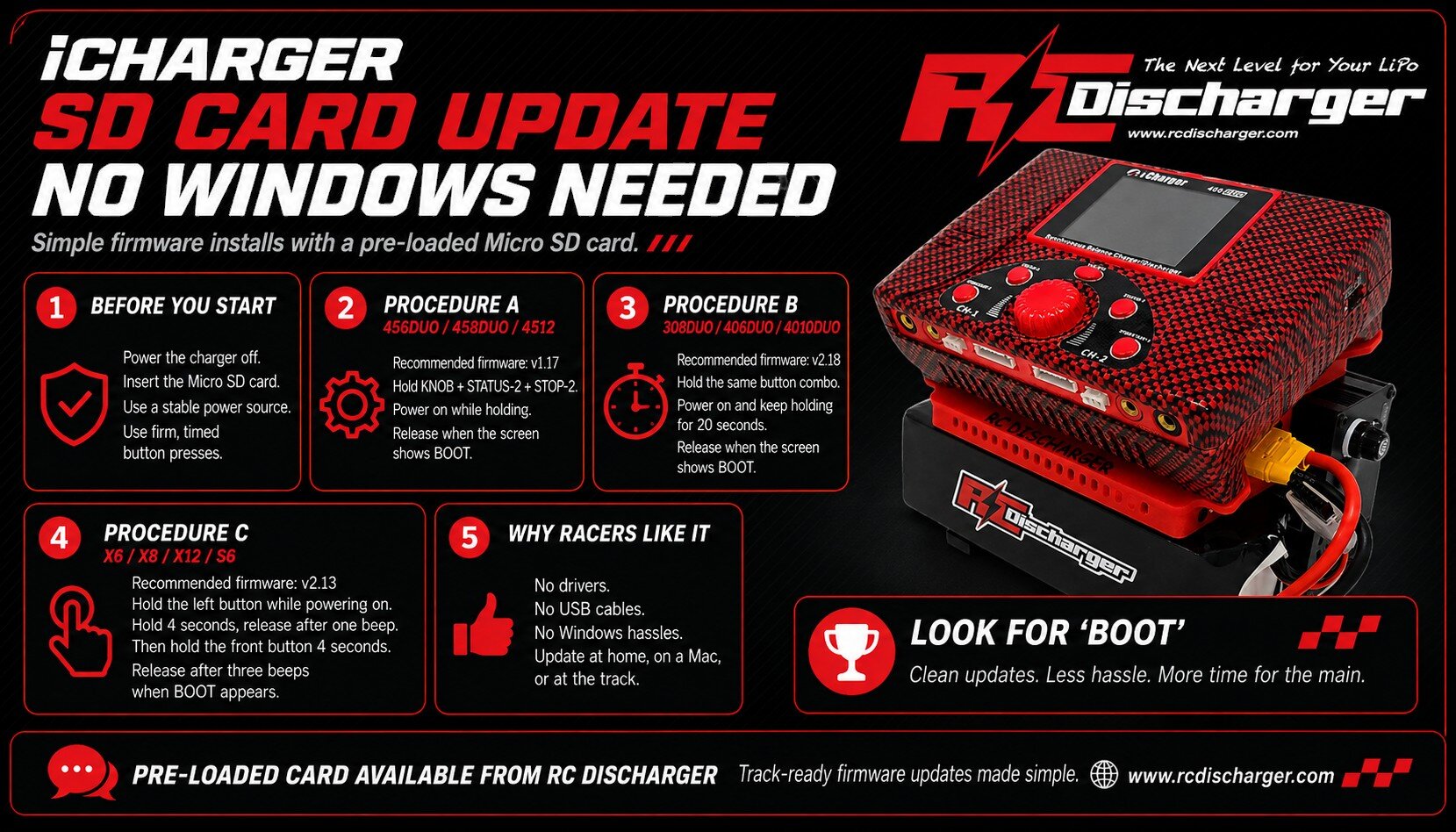
Procedure A: 456DUO, 458DUO, and 4512 series

Recommended firmware: v1.19

  1. Insert: Plug the RC Discharger Micro SD Card into your charger slot.
  2. The combo: Press and hold KNOB + STATUS-2 + STOP-2.
  3. Power up: While holding the buttons, power on the charger.
  4. Release: As soon as the screen changes and shows “Boot”, release the buttons.
Procedure B: 308DUO, 406DUO, and 4010DUO

Recommended firmware: v2.18

  1. Insert: Plug the RC Discharger Micro SD Card into your charger slot.
  2. The combo: Press and hold KNOB + STATUS-2 + STOP-2.
  3. Power & wait: While holding the buttons, power on the charger. Then keep holding for 20 seconds.
  4. Release: After 20 seconds, when the screen shows “Boot”, release the buttons.

Procedure C: X6, X8, X12, and S6

Recommended firmware: v2.13

  1. Insert: Plug the RC Discharger Micro SD Card into your charger slot.
  2. Press: Press and hold the button to the left.
  3. Power up: While holding the button, power on the charger. Then hold for 4 seconds, and release after one beep.
  4. Press: Next, press and hold the button toward you for 4 seconds.
  5. Release: After three beeps, the charger enters “Boot” mode. Then release the button.

Troubleshooting for a clean flash

However, if you do not see “Boot,” start over and re-check the button timing. Also, confirm you fully seat the Micro SD card in the slot. Additionally, use a known-good power supply so voltage stays steady. Meanwhile, if the charger restarts during the process, stop and fix the power issue first. Then repeat the steps from the beginning. As a result, you reduce the risk of a corrupted firmware load.

Get race-ready now

Now you can finish an iCharger SD card update with no drivers, no cables, and no Windows hassles. Additionally, fresh firmware helps you stay consistent through long mains and busy race weekends. Ultimately, a clean update process saves time when every round counts. In addition, the pre-loaded card removes guesswork, so you spend less time in the pits.

Get your pre-loaded card here: iCharger Firmware Update Micro SD Card | RC Discharger
iCharger firmware update guide

iCharger firmware update guide for race day

iCharger firmware update matters before you cycle packs on race day. Therefore, you prevent odd charger behavior in the pits. Moreover, you keep your Regenerative Discharger and charger pairing consistent. Before a long conditioning session, take 30 seconds to confirm the software. As a result, your discharge steps stay smooth and predictable.

Additionally, a quick check helps you avoid connection hiccups on busy days. Consequently, you spend less time troubleshooting and more time focusing on driving. Furthermore, you protect consistency across stock and modified programs.

Quick check: find your firmware version

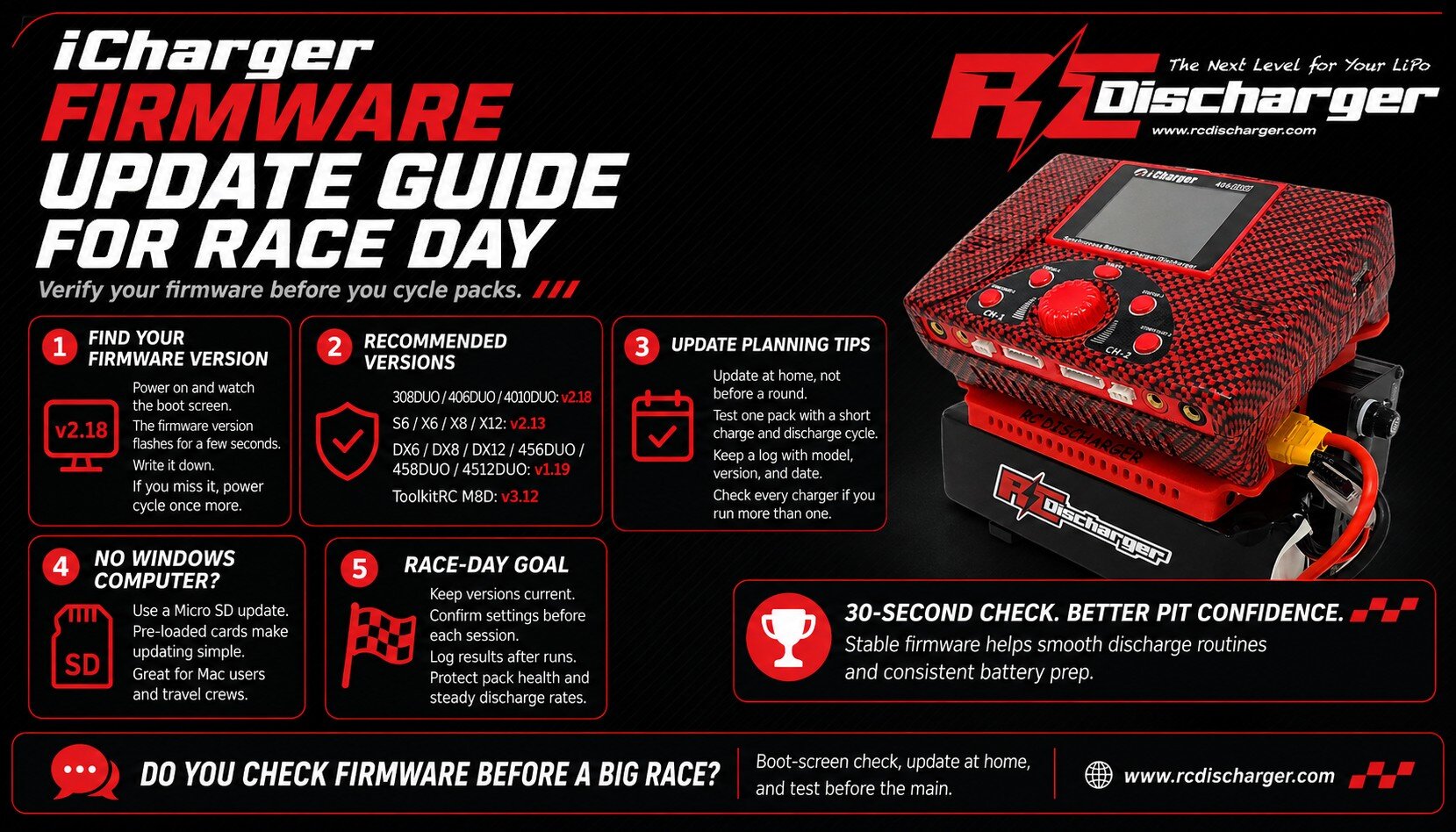
First, power on your charger and watch the screen right away. During boot, the firmware version flashes for a few seconds. Then, write it down so you can compare it to your target version. If you miss the flash, simply power cycle once more.

Consequently, you confirm the version without digging through menus. In addition, this habit keeps your routine consistent from practice to mains. Finally, you reduce last-minute surprises when you swap packs fast.

Recommended firmware versions for race reliability

Next, match your charger model to a proven version before a big weekend. Notably, stable firmware helps prevent glitches during discharge routines. Furthermore, consistent versions reduce surprises when you move between chargers.

  • v2.18 for iCharger 308DUO, 406DUO, 4010DUO
  • v2.13 for iCharger S6, X6, X8, X12
  • v1.19 for iCharger DX6, DX8, DX12, 456DUO, 458DUO, 4512DUO
  • v3.12 for ToolkitRC M8D

However, if your version differs, plan the update before your next major event. Similarly, if you run multiple chargers, check each one to avoid mixed behavior. For reference, review firmware for embedded electronics and see why version control matters.

Update planning tips that prevent pit-day problems

First, update at home, not five minutes before a round. Then, run a short charge and discharge test on one pack. As a result, you confirm stable communication before you commit to a full conditioning cycle.

Additionally, keep a simple log with charger model, firmware version, and date. Consequently, you spot changes quickly if behavior shifts. Moreover, you can match results across events and track conditions.

  1. Charge one pack at your normal race rate.
  2. Run a brief discharge step and watch for errors.
  3. Confirm leads, balance taps, and connectors stay snug.
  4. Finally, repeat once with a second pack for confidence.

No Windows computer? Use a Micro SD update

Updating an iCharger often needs a Windows PC. Nevertheless, you can still update quickly at home or at the track. Therefore, many racers keep a dedicated Micro SD option in their pit box for fast recovery.

The iCharger Firmware Update Micro SD Card offers a simple path to current firmware. In fact, we can ship a pre-loaded Micro SD card so you update directly without a computer. Consequently, Mac users and travel crews stay ready for race day.

Get the SD Card or download the files here: iCharger Firmware Update Micro SD Card from RC Discharger

Finally, confirm versions before each session and log results after runs. As a result, you protect pack health, maintain steady discharge rates, and keep your program sharp for the main.

Track-side iCharger and battery conditioning setup photo

Recommended iCharger firmware version chart image

RC Discharger