
Regenerative Discharger for iCharger and ToolkitRC
A regenerative discharger helps your packs drop internal resistance for stronger, steadier power. As a result, you gain speed, torque, and repeatable lap times. Moreover, you stop chasing a one-lap wonder and build race-long consistency.
Consistency wins races, because you need the same punch every lap. Therefore, our regenerative cycling approach targets voltage sag and uneven delivery. Additionally, it helps your battery feel the same at the start and the finish.
Compatibility beyond limits
First, this unit supports the full Junsi iCharger lineup and the ToolkitRC M8D. Next, you can run Cycle Mode on supported iCharger models without bulky resistor banks. Consequently, your pit setup stays clean while you condition packs at race-relevant loads.
- iCharger DUO Series: 456DUO, 458DUO, 4512DUO, 406DUO, 308DUO, 4010DUO
- iCharger Compact Series: DX6, DX8, DX12, S6, X6, X8, X12
- ToolkitRC: M8D
Maximize consistency every run
High internal resistance causes voltage sag and a random feel on throttle. However, deep cycling with regenerative recovery helps your packs deliver predictable output. In addition, you can tune gearing and timing with more confidence.
- Stable voltage: hold higher voltage under load for longer pulls.
- Race-ready conditioning: prep packs for high-stress mains without fading.
- Repeatable feel: match punch from practice through the final.
Maximize speed with real load cycling
To unlock motor performance, you need a battery that feeds current without bottlenecks. Therefore, higher discharge capability during cycling matters. For example, you can simulate race loads instead of babying packs with low-current banks.
- Synchronous mode advantage: discharge a single battery up to 70A.
- Dual channel throughput: run two packs at up to 45A per channel.
- Cleaner workflow: cycle faster and spend more time on setup.
Minimize internal resistance with energy recovery
Internal resistance (IR) fights power, heat, and consistency. Consequently, regular high-amp cycling at 30A to 70A pushes IR lower than typical resistor solutions. Additionally, regenerative recovery reuses energy instead of dumping it as heat.
If you want the science behind resistance, review battery internal resistance and voltage sag. Notably, lower IR often means less drop under load and more usable punch.
Smart design with zero hassle
We built this system to save space and simplify your routine. Moreover, you connect your charger and start cycling fast. Finally, the all-in-one footprint keeps wiring short and tidy.
- No resistor banks required: run Cycle Mode on iCharger S6, X6, X8, and X12.
- Plug-and-play: connect your iCharger and cycle without complex setup.
- All-in-one solution: keep charger and power supply in one clean footprint.
Specifications and versions
First, choose the version that matches your class and voltage needs. Next, scale your program as you add channels or move to 4S. Accordingly, you can keep the same workflow across stock and modified days.
- Synchronous discharge: up to 70A
- Dual discharge: up to 45A per channel
- Versions: 2S, 4S Off-Road, and 4S On-Road (1/8GTe)
- Upgrades: 4S upgrade path for DUO users
Designed by enthusiasts, made in the U.S.A.
We designed this regenerative discharger for racers who demand repeatable power. Therefore, we focus on precision, durability, and real race results. Ultimately, you get more speed, lower resistance, and stronger consistency across every pack.
Next, add this tool to your weekly routine and track IR, voltage hold, and lap times. Consequently, you will spot stronger packs faster and race with more confidence.
-

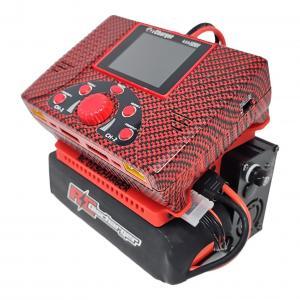
Regenerative Discharger 4S Off-Road
$399.99 Select options This product has multiple variants. The options may be chosen on the product page -

iCharger Temperature Sensor for LiPo Battery
$19.99 Select options This product has multiple variants. The options may be chosen on the product page -
Adapter Charger for Regenerative Discharger and Charger Stand
$14.99 Select options This product has multiple variants. The options may be chosen on the product page -
2S 45A Charge Cable (XT90 to 5mm) with Temperature Sensor
$39.99 Select options This product has multiple variants. The options may be chosen on the product page -
Premium Hard Case for Regenerative Discharger
$39.99 Add to cart -
12V Option for Regenerative Discharger
$49.99 Select options This product has multiple variants. The options may be chosen on the product page -
Folding Charger Stand V2
$24.99 Select options This product has multiple variants. The options may be chosen on the product page -
Lipo Safe Bag Kit for Our Regenerative Discharger
Price range: $32.99 through $46.99 Select options This product has multiple variants. The options may be chosen on the product page -
2S 40A Charge Cable (4mm to 5mm) with Temperature Sensor
$39.99 Add to cart -
RC Car Stand for Regenerative Discharger
Price range: $49.99 through $79.99 Select options This product has multiple variants. The options may be chosen on the product page -
RCD Link – Wireless iCharger Connection for Android, iPad & Windows
$49.99 Select options This product has multiple variants. The options may be chosen on the product page -
RC Tire Break-in Machine V2.1
$199.99 Select options This product has multiple variants. The options may be chosen on the product page -
Regenerative Discharger 2S
$329.99 Select options This product has multiple variants. The options may be chosen on the product page -
RC Discharger Battery Benchmark Printer
$59.99 Add to cart -
2S 32A Charge Cable (XT60 to 5mm) with Temperature Sensor
$39.99 Select options This product has multiple variants. The options may be chosen on the product page -
Regenerative Discharger 4S Off-Road – Air Travel Version
$449.99 Select options This product has multiple variants. The options may be chosen on the product page -
4S 45A Charge Cable (XT90 to 5mm) with Temperature Sensor
$49.99 Add to cart -
ToolkitRC M8D
$139.99 Add to cart -
Regenerative Discharger 2S On-Road V3
$349.99 Select options This product has multiple variants. The options may be chosen on the product page -
Regenerative Discharger 4S On-Road
$559.99 Select options This product has multiple variants. The options may be chosen on the product page -
Regenerative Discharger 2S On-Road V3 – Air Travel Version
$379.99 Select options This product has multiple variants. The options may be chosen on the product page -
Regenerative Discharger 2S – Bruno Coelho US Edition
Price range: $399.99 through $649.99 Select options This product has multiple variants. The options may be chosen on the product page -
Premium Hard Case for RC Tire Break-In Machine V2
$29.99 Add to cart -
Air Travel Kit for Regenerative Discharger | TSA Compliant
Price range: $99.99 through $249.99 Select options This product has multiple variants. The options may be chosen on the product page -
Premium Hard Case for Regenerative Discharger 4S On-Road
$49.99 Add to cart -
Hobbywing XeRun V10 G5 Motor
$159.99 Select options This product has multiple variants. The options may be chosen on the product page -
Premium Hard Case for 1/10 On-Road Cars
$79.99 Add to cart -
Upgrade DUO to Regenerative Discharger 4S V2 Off-Road
$199.99 Select options This product has multiple variants. The options may be chosen on the product page -
RC Discharger High-Output LED Pit Light for our Regenerative Discharger
$59.99 Select options This product has multiple variants. The options may be chosen on the product page -
Charger Riser for Regenerative Dischargers
$19.99 Select options This product has multiple variants. The options may be chosen on the product page -
Regenerative Discharger 4S On-Road – Air Travel Version
$599.99 Select options This product has multiple variants. The options may be chosen on the product page -
RC Discharger Battery Benchmark
GET THE APP