
LiPo Break-In Setup iCharger Plan

LiPo Break-In Setup for iCharger

LiPo Break-In Setup helps a new pack avoid a flat first race run. First, never debut a brand new battery in a main. Instead, cycle it with a calm, planned sequence. Therefore, you help the chemistry settle with less stress and less heat.

Moreover, this approach aims for stable cells and cleaner punch. Additionally, you often see lower internal resistance after controlled early cycles. Consequently, you start your race program with more consistent power.

Who should use this plan

First, use this routine on brand new packs. Next, use it on packs you never cycled. Additionally, run it after a few weeks of storage. As a result, you reduce surprises when you return to the track.

  • Brand new batteries
  • Packs you never cycled
  • Packs that sat unused for weeks

However, stop the process if the pack heats up fast. Likewise, pause if a cell drifts far from the others. Then, investigate connectors, balance lead fit, and cell health.

Memory 1: Gentle awakening cycle

First, start with a mild cycle to stabilize early voltage behavior. Consequently, you build a safer baseline before higher current work. Meanwhile, keep the pack cool and watch for any unusual swelling.
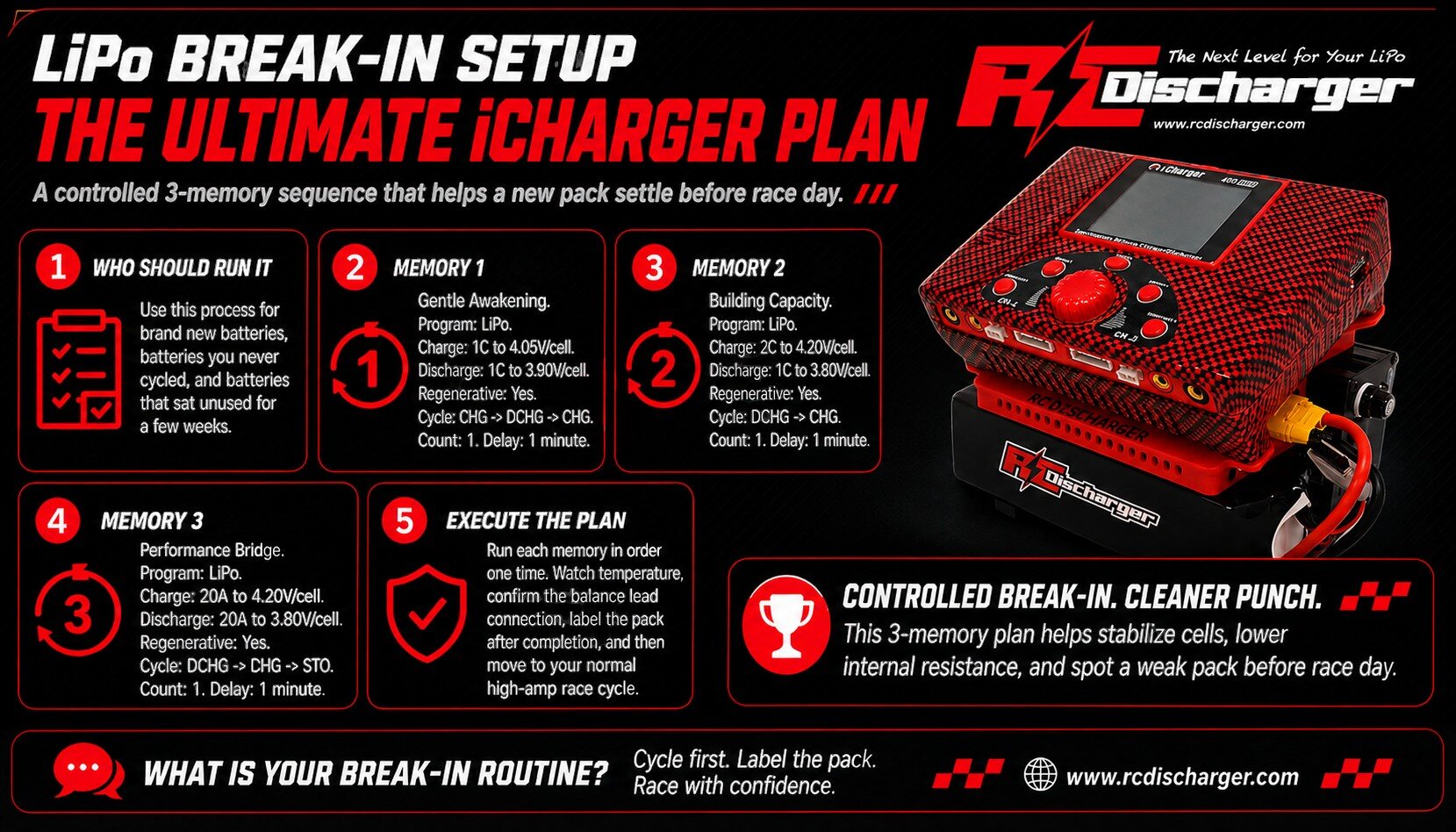
  • Program: LiPo
  • Charge: 1C rate | End-Voltage: 4.05V/cell
  • Discharge: 1C rate | Cut-off: 3.90V/cell (Regenerative: Yes)
  • Cycle Mode: CHG → DCHG → CHG | Count: 1 | Delay: 1 minute

Additionally, confirm airflow around the pack and charger. Therefore, you limit heat soak during the first conditioning pass.

Memory 2: Capacity-building cycle

Next, raise the charge rate to open up usable capacity. However, keep discharge conservative to protect the pack. As a result, you add work without pushing the cells too hard.

  • Program: LiPo
  • Charge: 2C rate | End-Voltage: 4.20V/cell
  • Discharge: 1C rate | Cut-off: 3.80V/cell (Regenerative: Yes)
  • Cycle Mode: DCHG → CHG | Count: 1 | Delay: 1 minute

Additionally, plug the balance lead firmly before you start. Consequently, the charger tracks each cell and keeps them aligned. Furthermore, log charge mAh and IR so you can spot trends early.

Memory 3: Performance bridge cycle

Then, bridge into higher current work with a controlled 20A cycle. Therefore, the pack responds closer to what you demand on track. Notably, this step also reveals weak cells before race day.

  • Program: LiPo
  • Charge: 20A | End-Voltage: 4.20V/cell
  • Discharge: 20A | Cut-off: 3.80V/cell (Regenerative: Yes)
  • Cycle Mode: DCHG → CHG → STO | Count: 1 | Delay: 1 minute

Finally, end at storage after the last charge step. Consequently, you can hold the pack safely until your next prep session. Meanwhile, store packs in a safe area and use common-sense fire safety.

How to run the 3-memory sequence

First, run each memory once in order, using cycle mode. Next, label the pack so you know it completed the sequence. Afterwards, move to your normal high-amp race cycle when you need peak output.

Moreover, review lithium polymer battery chemistry and safe handling before you push higher currents. Therefore, you protect your equipment and improve consistency. LiPo Break-In Setup also helps you catch a weak cell early, so you avoid wasting track time.
iCharger LiPo break-in setup reference image

Accurate IR readings for RC packs

Accurate IR readings for RC packs

Accurate IR readings help you confirm real punch and spot real fade. However, when values jump, you start guessing. Therefore, you need a repeatable routine that removes small errors. At RC Discharger, we focus on clean data that racers trust. Moreover, consistent IR lets you compare packs across days, not just single sessions. As a result, you can tune charge and discharge choices with confidence.

Start with tight, clean connections

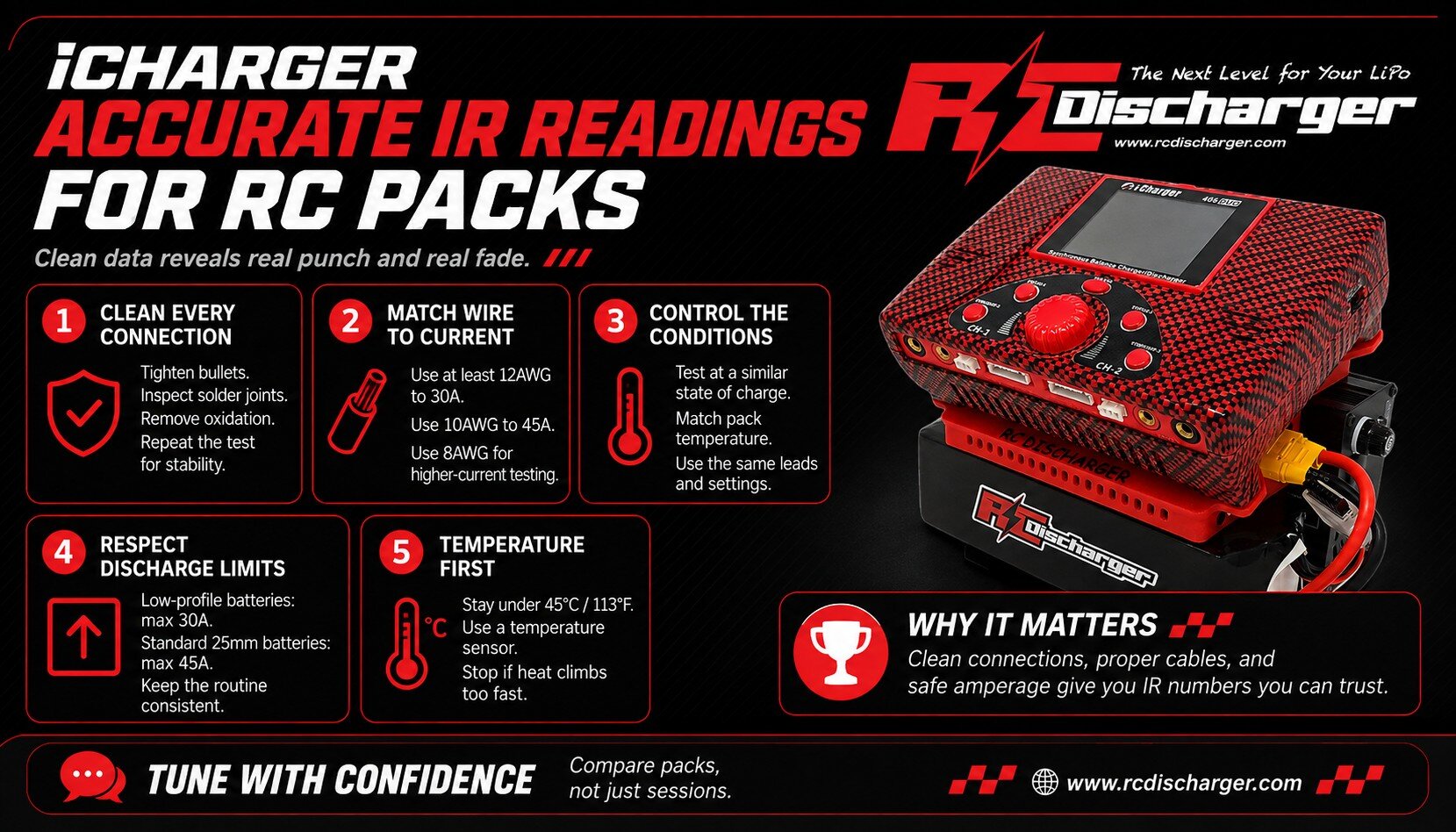
First, check every connector before you test. A loose 5mm bullet adds resistance and creates heat fast. Consequently, your meter reports higher IR that comes from the connection, not the cell. Next, inspect bullets, balance leads, and solder joints for oxidation or looseness. Also, wipe contact surfaces and fully reseat plugs before each run. Then, run one test cycle and repeat it to confirm stability.

Notably, team driver Ronnie Vasquez reduced IR swings after he tightened connectors and lowered amperage slightly. Therefore, treat these details like race prep, not like a quick chore. In addition, label your packs and record results so you can spot trends early.

Match cable gauge to your current

Second, choose wire that matches your test amperage. Thin wire warms up, and that heat shifts resistance during the test. In addition, hot leads can hide a strong pack and make it look weak. Therefore, use a simple gauge rule and stick to it every time.

  • Up to 30A: use at least 12AWG cable.
  • Up to 45A: use at least 10AWG cable.
  • Up to 70A: use at least 8AWG cable.

Similarly, keep leads short when possible. Moreover, avoid adapter stacks because each joint adds loss and variation. As a result, your readings reflect the pack more than the harness.

Respect pack size and discharge limits

Third, match discharge current to pack size and build. Too much current stresses the pack and can push cells out of balance. Consequently, you may create the sky-high IR you wanted to measure. Instead, follow conservative limits and keep conditions consistent.

  • Low-Profile Batteries: max 30A.
  • Standard (25mm) Batteries: max 45A.

Additionally, test at the same state of charge each time. For example, pick one SOC window and stay there for every pack. Thus, you compare pack health, not changing conditions. Likewise, let the pack rest a few minutes after charging so voltage settles.

Safety first: control temperature every time

Finally, monitor temperature during high-current cycles. Never let packs exceed 45°C (113°F). Therefore, you protect the pack and keep data stable. Also, use a dedicated sensor so you can react fast. Grab your sensor here: iCharger temperature sensor for LiPo battery.

In fact, heat changes resistance in wiring and connectors. Consequently, temperature swings can distort comparisons between sessions. If you want the theory behind that effect, review electrical resistance and conductance before your next test day. Ultimately, when you control connections, cables, current, and heat, Accurate IR readings become repeatable and useful.

RC Discharger