1/28 LiPo cycling for Peak Power
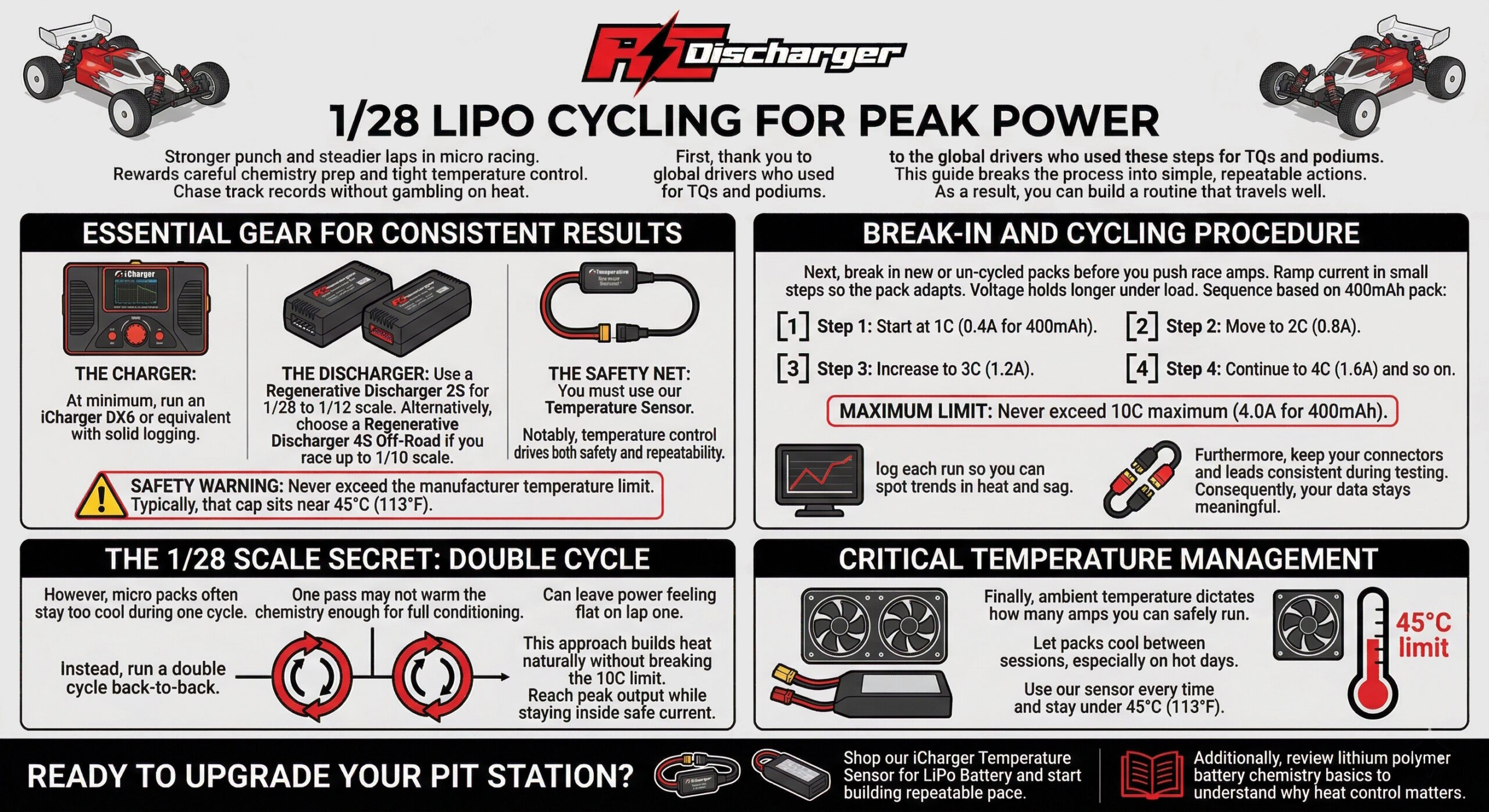
1/28 LiPo cycling helps you hit stronger punch and steadier laps in micro racing. Moreover, it rewards careful chemistry prep and tight temperature control. Therefore, you can chase track records without gambling on heat.
First, thank you to the global drivers who used these steps for TQs and podiums. Additionally, this guide breaks the process into simple, repeatable actions. As a result, you can build a routine that travels well.
Essential gear for consistent results
Before you start, gather the tools that keep your process stable. In addition, choose equipment that matches your scale and current needs. Consequently, you avoid guesswork between packs.
- The charger: At minimum, run an iCharger DX6 or equivalent with solid logging.
- The discharger: Use a Regenerative Discharger 2S for 1/28 to 1/12 scale. Alternatively, choose a Regenerative Discharger 4S Off-Road if you race up to 1/10 scale.
- The safety net: You must use our Temperature Sensor. Notably, temperature control drives both safety and repeatability.
Safety warning: Never exceed the manufacturer temperature limit. Typically, that cap sits near 45°C (113°F).
Break-in and cycling procedure
Next, break in new or un-cycled packs before you push race amps. Specifically, ramp current in small steps so the pack adapts. As a result, voltage holds longer under load.
Use this gradual sequence based on capacity. For example, a 400mAh pack uses the currents shown below. Then, stop increasing if temperature climbs too fast.
- Step 1: Start at 1C (0.4A for 400mAh).
- Step 2: Move to 2C (0.8A).
- Step 3: Increase to 3C (1.2A).
- Step 4: Continue to 4C (1.6A) and so on.
- Maximum limit: Never exceed 10C maximum (4.0A for 400mAh).
Meanwhile, log each run so you can spot trends in heat and sag. Furthermore, keep your connectors and leads consistent during testing. Consequently, your data stays meaningful.
The 1/28 scale secret: double cycle
However, micro packs often stay too cool during one cycle. Therefore, one pass may not warm the chemistry enough for full conditioning. In fact, that can leave power feeling flat on lap one.
Instead, run a double cycle back-to-back. Additionally, this approach builds heat naturally without breaking the 10C limit. As a result, you reach peak output while staying inside safe current.
Critical temperature management
Finally, ambient temperature dictates how many amps you can safely run. Consequently, let packs cool between sessions, especially on hot days. Moreover, use our sensor every time and stay under 45°C (113°F).
Ready to upgrade your pit station? Shop our iCharger Temperature Sensor for LiPo Battery and start building repeatable pace. Additionally, review lithium polymer battery chemistry basics to understand why heat control matters.