C Rating Explained: RC Charge Math
C Rating Explained starts with one goal: charge safely and keep packs strong. Therefore, you need to match charge amps to capacity. Moreover, the label numbers can look confusing at first. However, the math stays simple once you see it.
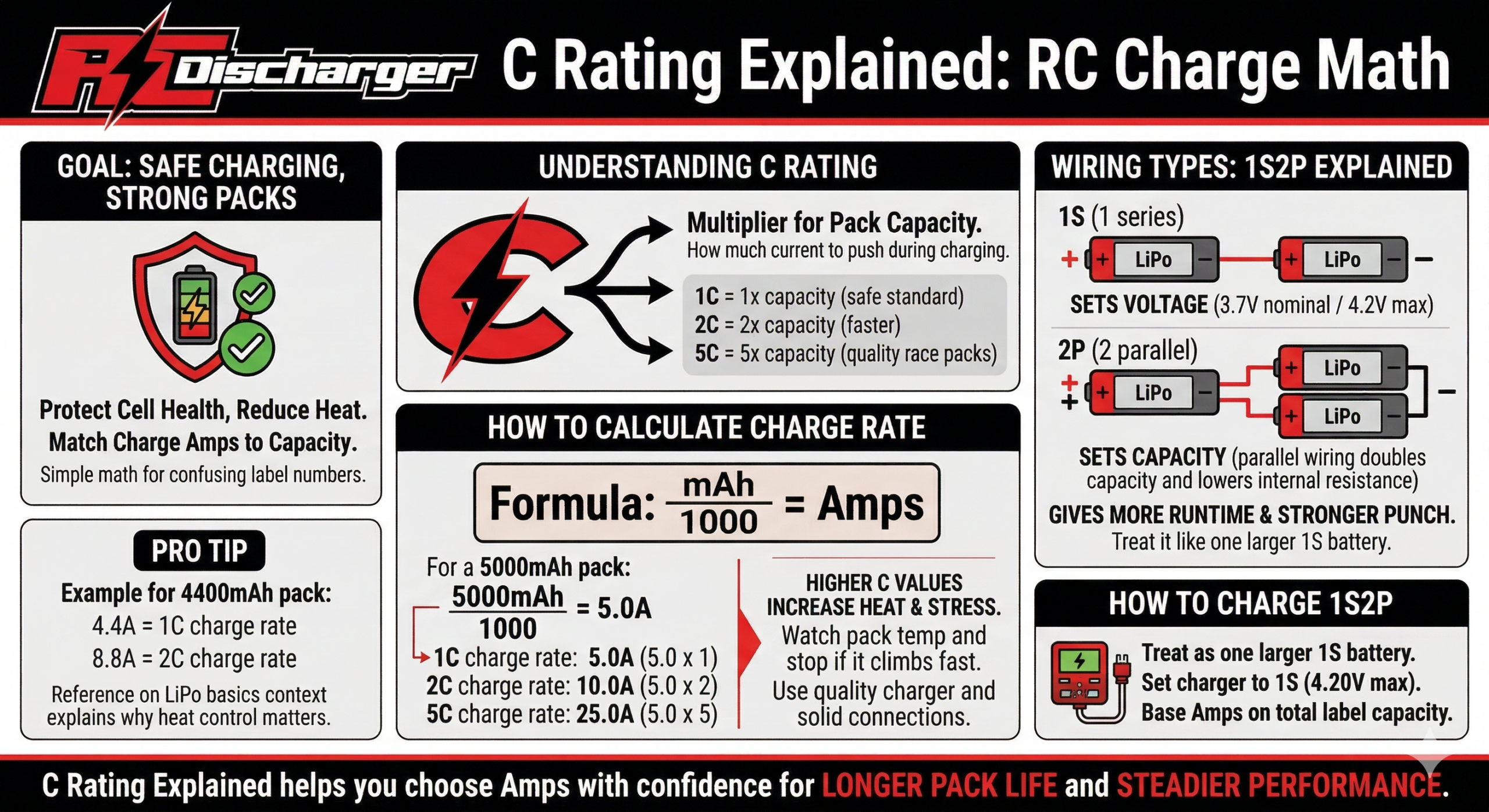
First, think of a C rating as a multiplier for your pack capacity. In addition, it tells you how much current you can push during charging. As a result, you protect cell health and reduce heat.
Understanding what a C rating means
Specifically, 1C equals one times your battery capacity in amps. For example, a 5000mAh pack equals 5.0A at 1C. Similarly, higher C values increase charge current. However, you should follow your pack maker limits.
- 1C = 1x capacity (a standard safe charge rate).
- 2C = 2x capacity (a faster charge rate).
- 5C = 5x capacity (fast charging for quality race packs).
Notably, charging faster can raise heat and stress. Therefore, watch pack temperature and stop if it climbs fast. Also, use a quality charger and solid connections.
How to calculate your charge rate
First, convert milliamp-hours to amps with one quick step. Then, multiply by the C rate you want. Consequently, you get the correct charger current setting.
- Formula: mAh / 1000 = Amps
The 5000mAh example: 5000mAh becomes 5.0A. Therefore, 1C equals 5.0A, and 2C equals 10.0A.
- 1C charge rate: 5.0A (5.0 x 1)
- 2C charge rate: 10.0A (5.0 x 2)
- 5C charge rate: 25.0A (5.0 x 5)
Pro tip: 4400mAh equals 4.4A. Thus, 1C equals 4.4A, and 2C equals 8.8A.
Additionally, you can confirm the idea with a reliable reference on lithium polymer battery charging basics. Moreover, that context helps you understand why heat control matters.
What 1S2P means for RC batteries
Next, you may see 1S2P on some 1/12 or GT12 packs. Although it looks technical, it simply describes wiring inside the case. Consequently, it tells you how voltage and capacity behave.
- 1S (1 series): sets voltage, so it matches one cell (3.7V nominal / 4.2V max).
- 2P (2 parallel): sets capacity, so two cells share the load side by side.
Importantly, parallel wiring doubles capacity and lowers internal resistance. As a result, you often get more runtime and stronger punch. However, voltage stays the same as a normal 1S pack.
So how do you charge it? You treat it like one larger 1S battery. Therefore, set the charger to 1S (4.20V max) and base amps on total label capacity.
- Voltage setup: set your charger to 1S (4.20V).
- Amps setup: calculate C from the total capacity on the label.
Finally, C Rating Explained helps you choose amps with confidence. Moreover, that simple habit supports longer pack life and steadier performance.