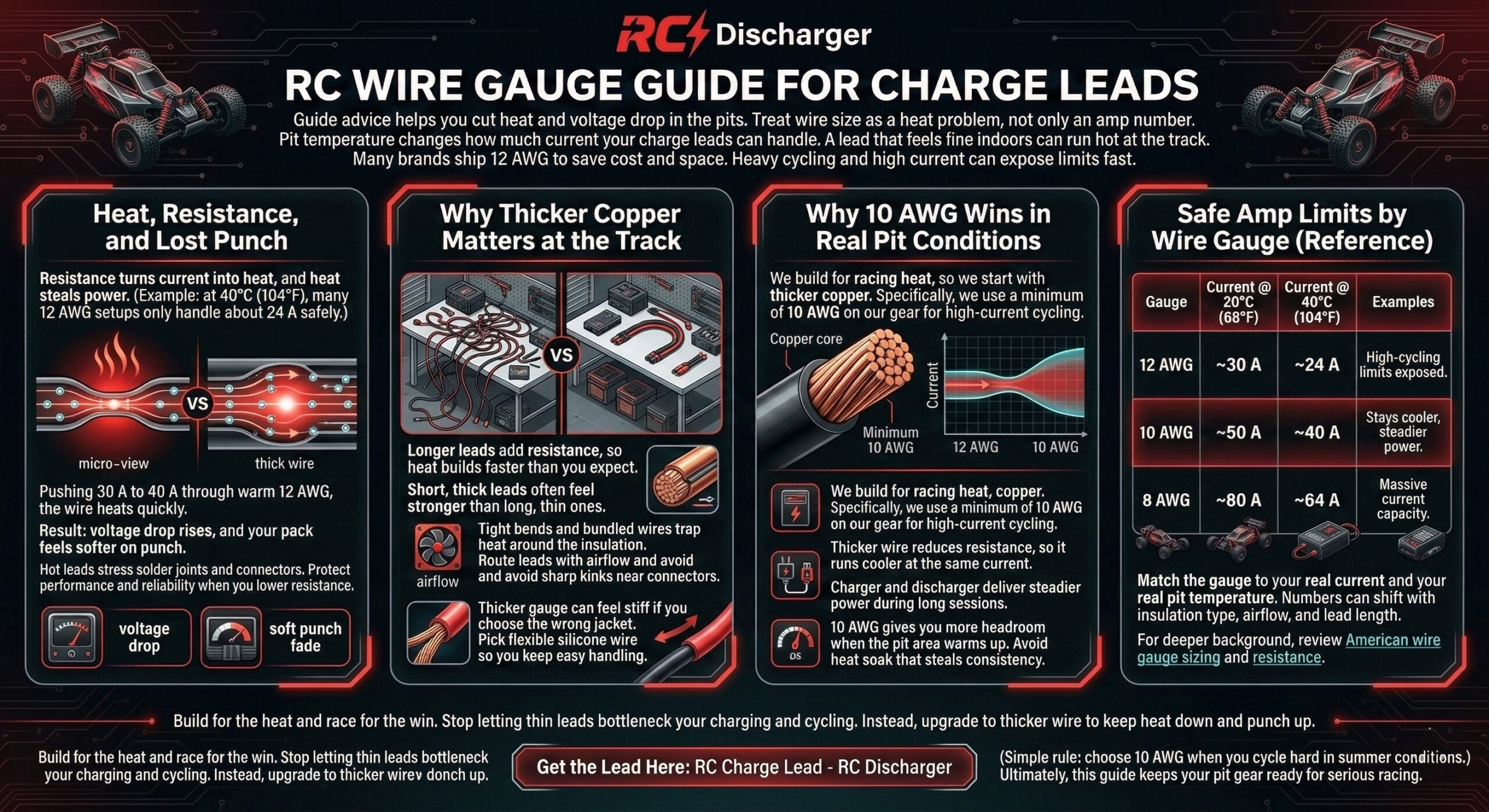
RC wire gauge guide for charge leads
RC wire gauge guide advice helps you cut heat and voltage drop in the pits. Therefore, treat wire size as a heat problem, not only an amp number.
Moreover, pit temperature changes how much current your charge leads can handle. Consequently, a lead that feels fine indoors can run hot at the track.
However, many brands ship 12 AWG to save cost and space. As a result, heavy cycling and high current can expose limits fast.
Heat, resistance, and lost punch
First, resistance turns current into heat, and heat steals power. For example, at 40°C (104°F), many 12 AWG setups only handle about 24 A safely.
Next, when you push 30 A to 40 A through warm 12 AWG, the wire heats quickly. As a result, voltage drop rises and your pack feels softer on punch.
In addition, hot leads stress solder joints and connectors. Therefore, you protect performance and reliability when you lower resistance.
Why thicker copper matters at the track
Additionally, longer leads add resistance, so heat builds faster than you expect. Consequently, short, thick leads often feel stronger than long, thin ones.
Moreover, tight bends and bundled wires trap heat around the insulation. Therefore, route leads with airflow and avoid sharp kinks near connectors.
On the other hand, a thicker gauge can feel stiff if you choose the wrong jacket. Thus, pick flexible silicone wire so you keep easy handling.
Why 10 AWG wins in real pit conditions
We build for racing heat, so we start with thicker copper. Specifically, we use a minimum of 10 AWG on our gear for high-current cycling.
Moreover, thicker wire reduces resistance, so it runs cooler at the same current. Consequently, your charger and discharger deliver steadier power during long sessions.
Similarly, 10 AWG gives you more headroom when the pit area warms up. Thus, you avoid heat soak that steals consistency.
Safe amp limits by wire gauge
Use this quick reference before you choose leads for your race program. Then, match the gauge to your real current and your real pit temperature.
- 12 AWG: ~30 A at 20°C (68°F), ~24 A at 40°C (104°F)
- 10 AWG: ~50 A at 20°C (68°F), ~40 A at 40°C (104°F)
- 8 AWG: ~80 A at 20°C (68°F), ~64 A at 40°C (104°F)
Notably, these numbers can shift with insulation type, airflow, and lead length. For deeper background, review American wire gauge sizing and resistance.
Build for the heat and race for the win
Finally, stop letting thin leads bottleneck your charging and cycling. Instead, upgrade to thicker wire to keep heat down and punch up.
Get the Sensor Here: RC Charge Lead – RC Discharger
If you want a simple rule, choose 10 AWG when you cycle hard in summer conditions. Ultimately, this RC wire gauge guide keeps your pit gear ready for serious racing.