
LiPo battery safety for RC racing

LiPo battery safety for RC racing

LiPo battery safety starts when you treat every pack like race fuel. Therefore, you protect power, runtime, and your pit area.

At RC Discharger, we want you fast and safe. Moreover, these simple habits help you avoid swelling, damage, and fires.

In addition, build a routine you follow every race day. As a result, your packs stay consistent from practice to the main.

The “Never” rules: voltage and time

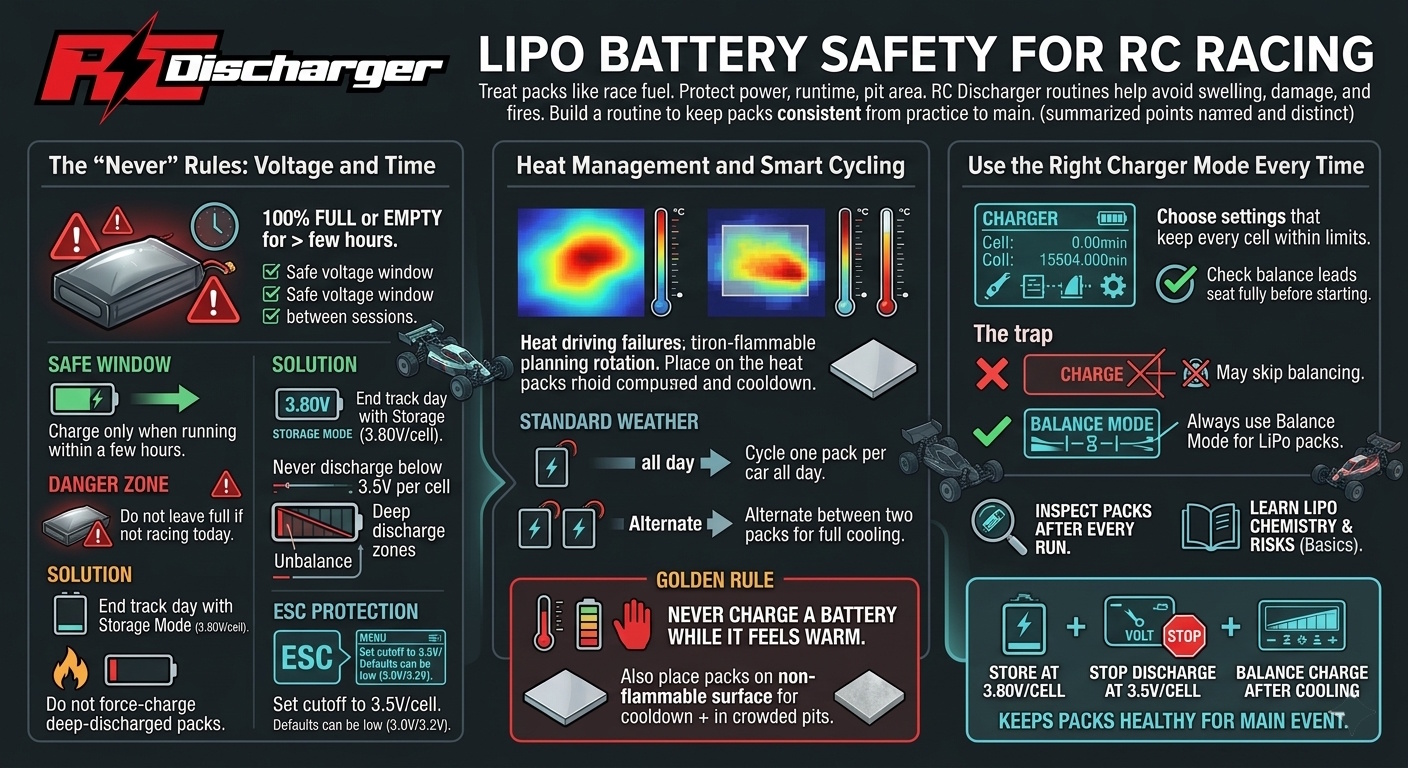
First, never leave a battery full or empty for more than a few hours. Instead, keep packs in a safe voltage window between sessions.

  1. Never leave a battery 100% full or “empty” for more than a few hours.
  • The safe window: Charge a pack when you plan to run within a few hours.
  • The danger zone: However, do not leave it full if you will not race today.
  • The solution: Therefore, end every track day with Storage Mode at about 3.80V per cell.

Second, never discharge below 3.5V per cell. Consequently, you avoid the deep discharge zone that ruins the chemistry.

  1. Never discharge below 3.5V per cell.
  • Specifically, dropping below 3.0V per cell can cause permanent damage.
  • Fire risk: Moreover, do not force-charge a pack that you drained too low.

Set ESC protection before you race

Next, do not guess when to pull off the track. Instead, set your ESC to protect the pack every run.

Also, confirm settings after firmware updates or resets. Otherwise, a default cutoff can drop too low.

  • Set your Low Voltage Cutoff (LVC): Open your ESC programming menu.
  • The target: Set cutoff to 3.5V per cell.
  • The warning: However, many defaults sit at 3.0V or 3.2V per cell.
  • The result: Therefore, a 3.5V setting helps you stay in the safe zone.

Heat management and smart cycling

Heat drives most failures. Accordingly, plan your battery rotation around ambient temperature and cooldown time.

Meanwhile, watch pack temperature after long mains. Then, wait until the pack feels cool before you charge.

  • Standard weather: Generally, you can cycle one pack all day per car.
  • Hot weather: Meanwhile, alternate between two packs so each one cools fully.
  • The golden rule: Above all, never charge a battery while it feels warm.

Also, place packs on a non-flammable surface during cooldown. For example, a ceramic tile reduces risk in crowded pits.

Use the right charger mode every time

Using the wrong mode causes many pit fires. Therefore, choose settings that keep every cell within limits.

Additionally, check that balance leads seat fully before you start. Consequently, you avoid a bad connection that hides a weak cell.

  • The trap: On many chargers, “Charge” mode may skip balancing.
  • The fix: Consequently, always use Balance Mode for LiPo packs.

Finally, learn the basics of lithium polymer battery chemistry and risks so you spot problems early. LiPo battery safety improves when you inspect packs after every run.

Ultimately, store at about 3.80V per cell, stop at 3.5V per cell, and balance charge after cooling. Thus, you keep your packs healthy for the main event.
 

LiPo Battery Safety for High Amps

LiPo battery safety for high-amp cycling

LiPo battery safety starts with smart cycling habits and real data. Therefore, you protect packs, speed, and your pit area. Moreover, you avoid heat damage that kills punch and consistency.

At RC Discharger, we build routines around repeatable numbers, not guesswork. In addition, we suggest you log temps, amps, and cycle time every session. As a result, you spot trends early and save your best packs for mains.

Start with a storage charge

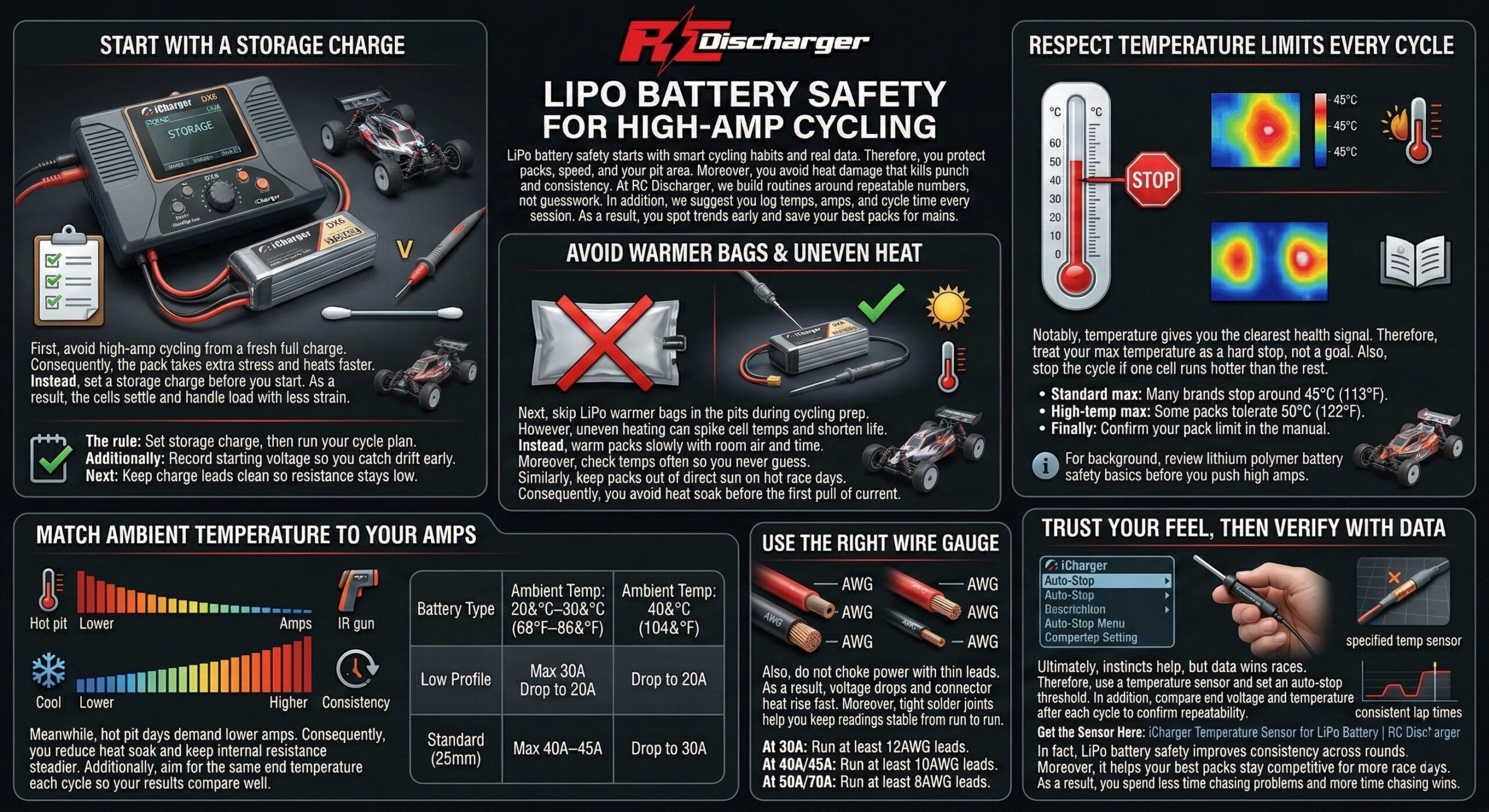
First, avoid high-amp cycling from a fresh full charge. Consequently, the pack takes extra stress and heats faster. Instead, set a storage charge before you start. As a result, the cells settle and handle load with less strain.

  • The rule: Set storage charge, then run your cycle plan.
  • Additionally: Record starting voltage so you catch drift early.
  • Next: Keep charge leads clean so resistance stays low.

Avoid warmer bags and uneven heat

Next, skip LiPo warmer bags in the pits during cycling prep. However, uneven heating can spike cell temps and shorten life. Instead, warm packs slowly with room air and time. Moreover, check temps often so you never guess.

Similarly, keep packs out of direct sun on hot race days. Consequently, you avoid heat soak before the first pull of current.

Respect temperature limits every cycle

Notably, temperature gives you the clearest health signal. Therefore, treat your max temperature as a hard stop, not a goal. Also, stop the cycle if one cell runs hotter than the rest.

  • Standard max: Many brands stop around 45°C (113°F).
  • High-temp max: Some packs tolerate 50°C (122°F).
  • Finally: Confirm your pack limit in the manual.

For background, review lithium polymer battery safety basics before you push high amps.

Match ambient temperature to your amps

Meanwhile, hot pit days demand lower amps. Consequently, you reduce heat soak and keep internal resistance steadier. Additionally, aim for the same end temperature each cycle so your results compare well.

Battery Type Ambient Temp: 20°C–30°C (68°F–86°F) Ambient Temp: 40°C (104°F)
Low Profile Max 30A Drop to 20A
Standard (25mm) Max 40A–45A Drop to 30A

Use the right wire gauge

Also, do not choke power with thin leads. As a result, voltage drops and connector heat rise fast. Moreover, tight solder joints help you keep readings stable from run to run.

  • At 30A: Run at least 12AWG leads.
  • At 40A/45A: Run at least 10AWG leads.
  • At 50A/70A: Run at least 8AWG leads.

Trust your feel, then verify with data

Ultimately, instincts help, but data wins races. Therefore, use a temperature sensor and set an auto-stop threshold. In addition, compare end voltage and temperature after each cycle to confirm repeatability.

Get the Sensor Here: iCharger Temperature Sensor for LiPo Battery | RC Discharger

In fact, LiPo battery safety improves consistency across rounds. Moreover, it helps your best packs stay competitive for more race days. As a result, you spend less time chasing problems and more time chasing wins.

RC Discharger