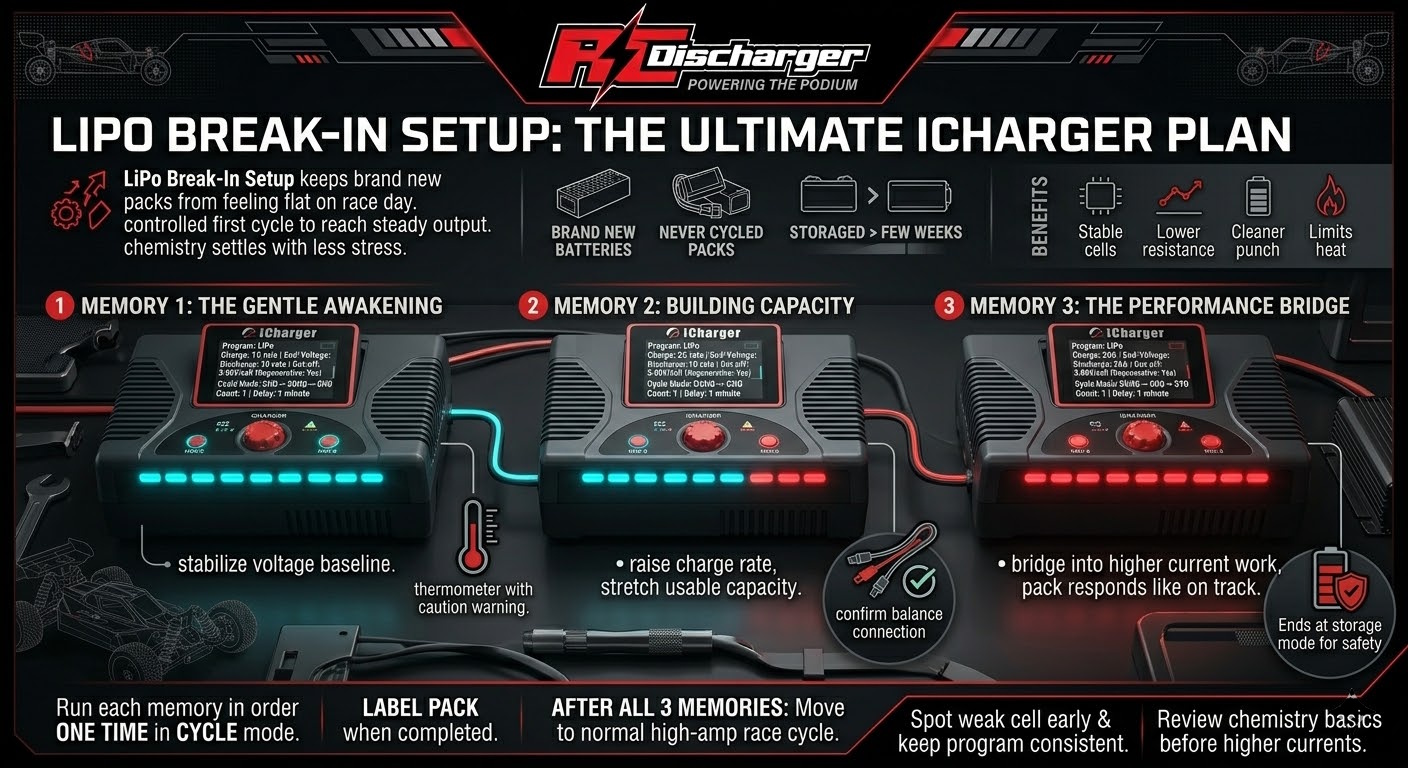
LiPo Break-In Setup: The Ultimate iCharger Plan
LiPo Break-In Setup keeps a brand new pack from feeling flat on race day.
Never use a brand new battery for the first time in a race. Instead, cycle it first.
However, a fresh pack often needs a controlled first cycle to reach steady output. Therefore, this iCharger sequence helps the chemistry settle with less stress.
Who should run this procedure
First, use this process on brand new batteries. Next, use it on packs you never cycled. Additionally, use it after a few weeks of storage.
- Brand new batteries
- Batteries you have never cycled
- Batteries that sat unused for a few weeks
Moreover, this 3-memory approach targets stable cells, lower internal resistance, and cleaner punch. In addition, it limits heat so you avoid early wear.
Memory 1: The Gentle Awakening
First, start with a mild cycle to stabilize voltage behavior. As a result, you build a safer baseline before higher current work.
- Program: LiPo
- Charge: 1C rate | End-Voltage: 4.05V/cell
- Discharge: 1C rate | Cut-off: 3.90V/cell (Regenerative: Yes)
- Cycle Mode: CHG -> DCHG -> CHG | Count: 1 | Delay: 1 minute
Meanwhile, watch pack temperature during this step. Consequently, you can stop early if you feel unusual heat.
Memory 2: Building Capacity
Next, raise the charge rate to stretch usable capacity. However, keep discharge conservative to protect the pack.
- Program: LiPo
- Charge: 2C rate | End-Voltage: 4.20V/cell
- Discharge: 1C rate | Cut-off: 3.80V/cell (Regenerative: Yes)
- Cycle Mode: DCHG -> CHG | Count: 1 | Delay: 1 minute
Additionally, confirm your balance lead connection before you start. Therefore, the charger can track each cell and keep them aligned.
Memory 3: The Performance Bridge
Then, bridge into higher current work with a controlled 20A cycle. As a result, the pack responds more like it will on track.
- Program: LiPo
- Charge: 20A | End-Voltage: 4.20V/cell
- Discharge: 20A | Cut-off: 3.80V/cell (Regenerative: Yes)
- Cycle Mode: DCHG -> CHG -> STO | Count: 1 | Delay: 1 minute
Notably, this step ends at storage after the final charge step. Consequently, you can hold the pack safely until your next race prep.
How to execute the 3-memory sequence
Run each memory in order one time in cycle mode. Afterwards, label the pack so you know it completed the process.
Finally, after all three memories, you can move to your normal high-amp race cycle. For background, review lithium polymer battery chemistry and handling before you push higher currents.
LiPo Break-In Setup also helps you spot a weak cell early. Therefore, you protect your equipment and keep your race program consistent.