LiPo Battery Cycling Tips for Racing
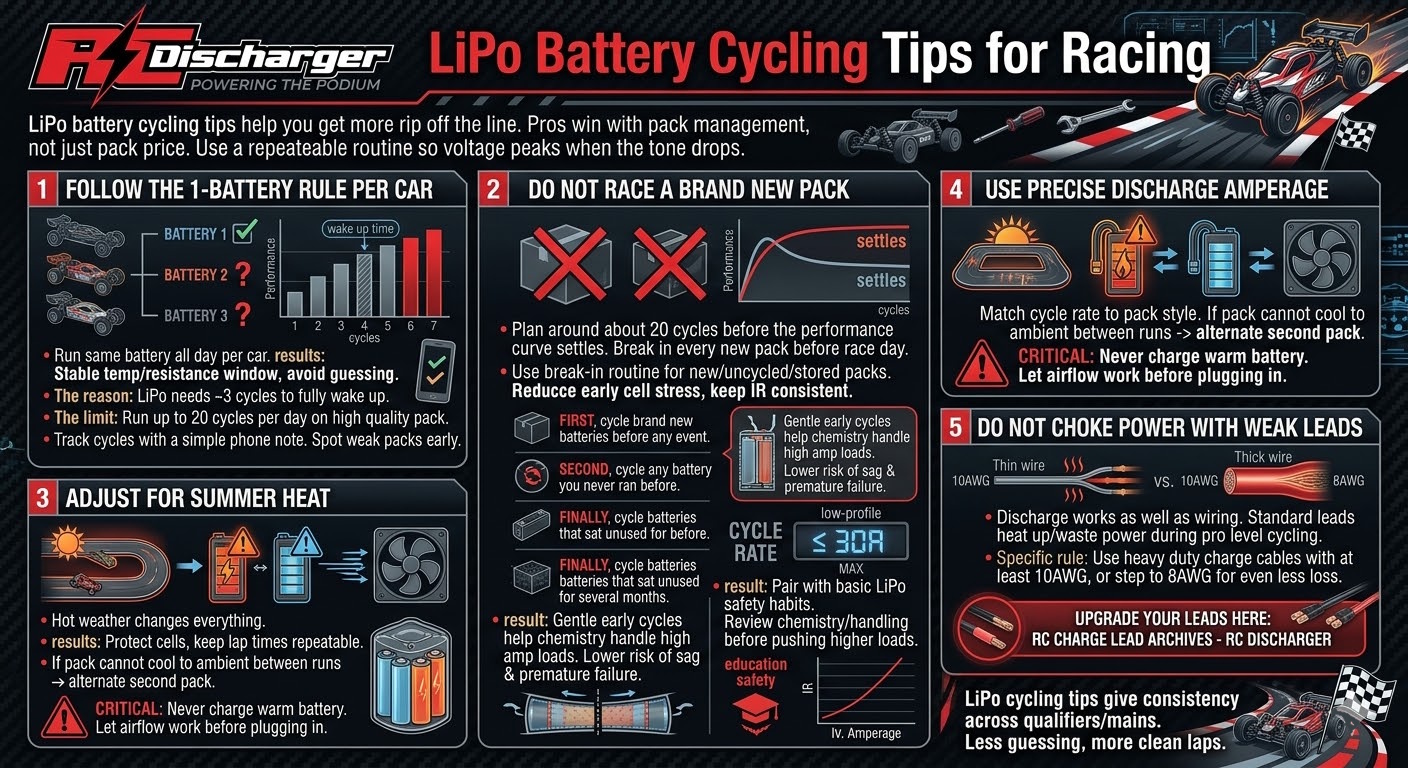
LiPo battery cycling tips help you get more rip off the line. Moreover, pros win with pack management, not just pack price. Therefore, use a repeatable routine so voltage peaks when the tone drops.
Follow the 1-battery rule per car
First, run the same battery all day for each car. As a result, the pack stays in a stable temperature and resistance window. Additionally, you avoid guessing which pack feels best.
- The reason: Typically, a LiPo needs about 3 cycles to fully wake up.
- The limit: Next, you can run up to 20 cycles per day on one high quality pack.
In addition, track cycles with a simple note on your phone. Consequently, you will spot weak packs before they cost you a main.
Do not race a brand new pack
However, a fresh pack rarely runs its fastest on cycle one. Instead, plan around about 20 cycles before the performance curve settles. Therefore, break in every new pack before race day.
Pro tip: Next, use a break-in routine for new packs, uncycled packs, or packs that sat for months. As a result, you reduce early cell stress and keep IR more consistent.
- First, cycle brand new batteries before any event.
- Second, cycle any battery you never ran before.
- Finally, cycle batteries that sat unused for several months.
For example, gentle early cycles help the chemistry handle high amp loads. Consequently, you lower the risk of sag and premature failure.
Adjust for summer heat
Meanwhile, hot weather changes everything. If a pack cannot cool back to ambient between runs, alternate with a second pack. Therefore, you protect the cells and keep lap times repeatable.
Critical: Never charge a battery while it still feels warm. Additionally, let airflow do the work before you plug in.
Use precise discharge amperage
Additionally, match your cycle rate to the pack style. For low profile batteries, keep the cycle rate at or under 30A. As a result, you hit a sweet spot for punch without over-stressing thin cells.
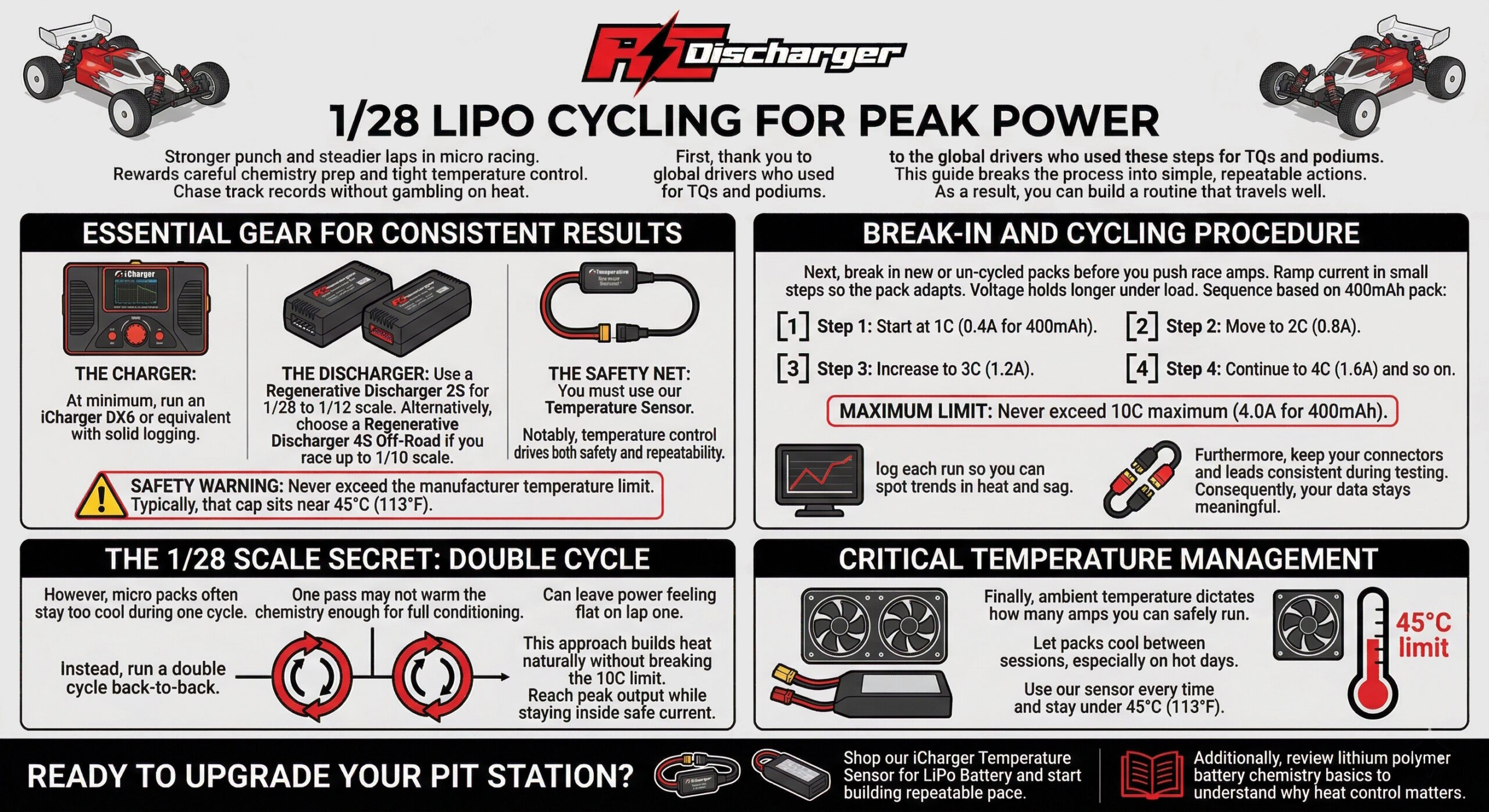
Moreover, these LiPo battery cycling tips pair well with basic LiPo safety habits. For example, review lithium polymer battery chemistry and handling before you push higher loads.
Do not choke power with weak leads
Finally, your discharge only works as well as your wiring. Standard leads often heat up and waste power during pro level cycling. Therefore, use heavy duty charge cables with at least 10AWG, or step to 8AWG for even less loss.
Upgrade your leads here: RC Charge Lead Archives – RC Discharger
Ultimately, LiPo battery cycling tips give you more consistency across qualifiers and mains. Consequently, you spend less time guessing and more time driving clean laps.