Accurate IR Readings for RC Packs
Accurate IR readings help you spot real battery punch and real battery fade. However, when numbers jump, you end up guessing. Therefore, you need a repeatable setup that removes small errors.
At RC Discharger, we focus on clean data for racers. Moreover, consistent IR helps you compare packs, not just sessions. As a result, you can tune your charge and discharge routine with confidence.
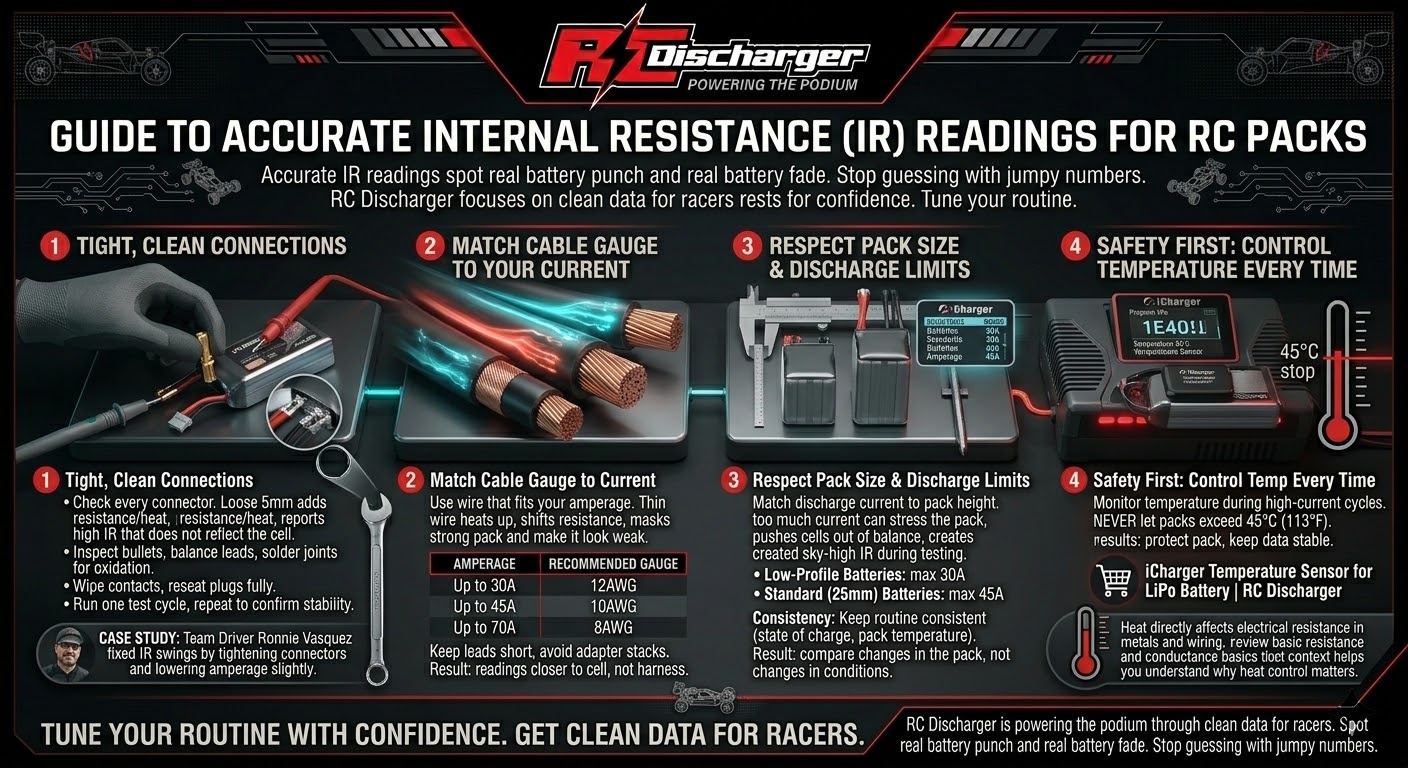
Start with tight, clean connections
First, check every connector before you test. A loose 5mm bullet adds resistance and heat fast. Consequently, your meter reports higher IR that does not reflect the cell.
Next, inspect bullets, balance leads, and solder joints for oxidation. Also, wipe contact surfaces and reseat plugs fully. Then, run one test cycle and repeat it to confirm stability.
Notably, team driver Ronnie Vasquez fixed IR swings by tightening connectors and lowering amperage slightly. Therefore, treat small details like race prep, not like a quick chore.
Match cable gauge to your current
Second, use wire that fits your amperage. Thin wire heats up, and heat shifts resistance during the test. In addition, hot leads can mask a strong pack and make it look weak.
- Up to 30A: use at least 12AWG cable.
- Up to 45A: use at least 10AWG cable.
- Up to 70A: use at least 8AWG cable.
Similarly, keep your leads short when possible. Moreover, avoid adapter stacks because each joint adds loss. As a result, your readings stay closer to the cell, not the harness.
Respect pack size and discharge limits
Third, match discharge current to pack height. Too much current can stress the pack and push cells out of balance. Consequently, you may see sky-high IR that you created during testing.
- Low-Profile Batteries: max 30A.
- Standard (25mm) Batteries: max 45A.
Additionally, keep your routine consistent from test to test. For example, test at the same state of charge and similar pack temperature. Thus, you compare changes in the pack, not changes in conditions.
Safety first: control temperature every time
Finally, monitor temperature during high-current cycles. Never let packs exceed 45°C (113°F). Therefore, you protect the pack and keep data stable.
Also, use a dedicated sensor so you can react fast. Grab your sensor here: iCharger Temperature Sensor for LiPo Battery | RC Discharger.
In fact, heat directly affects electrical resistance in metals and wiring. For a deeper overview, review electrical resistance and conductance basics before your next test session.